
Taiwan
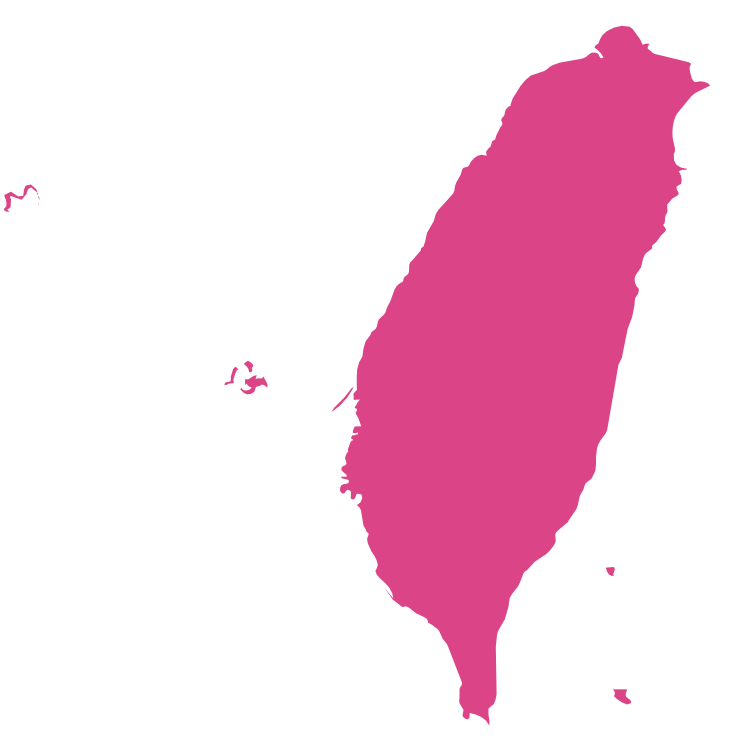
We have been working in Taiwan for almost 20 years, where the use of the death penalty is still an active and highly politicised issue.
Our collaborative strategies with the Taiwan Alliance to End the Death Penalty have been extensive. In 2024, through a direct legal challenge, we successfully limited the scope of the punishment. The work continues.
Taiwan is one of the few liberal democracies that still retains the death penalty. While the use of executions has fluctuated over time, capital punishment remains available in law and continues to be the subject of significant political and public debate. In recent years, court rulings have introduced restrictions limiting the scope of the punishment and improving procedural safeguards for people facing death sentences.
The death penalty remains a highly politicised issue in the country, with public opinion being central to justifications for its retention.
We started working in Taiwan with our local partner, the Taiwan Alliance to End the Death Penalty (TAEDP), in 2008. Our collaborative work has included taking legal action, publishing rigorous research, delivering training to members of the judiciary and engaging with decision-makers on criminal justice policy.
Of note, our extensive research has examined multiple aspects of the cultural and legal status of the death penalty. This includes analysis of Taiwan’s obligations under the International Covenant on Civil and Political Rights (ICCPR), the treatment of mental health in capital cases, reviews of wrongful convictions, and detailed studies of public and legislative attitudes towards capital punishment.
By joining wider legal teams mounting direct challenges to the legality of the death penalty in Taiwan, we have contributed to significant legal developments: in 2024, a Constitutional Court judgment in response to our challenge significantly reduced the number of crimes which are death penalty eligible. It also introduced wider legal protections for people facing death sentences. While the Court held that capital punishment was lawful under Taiwan’s Constitution, they clarified that its current application was not in line with international human rights standards – and ruled that this must be set right.
Despite the positive outcome of the Constitutional Court’s ruling, Taiwan resumed executions in early 2025 after a five-year pause. Huang Lin-kai (黃麟凱) was executed in January 2025. This shocking setback was unlawful and showed an indefensible disregard for due process: an appeal to his sentence was still pending before the courts.
Alongside TAEDP, we are devising new legal strategies to respond to this increasingly fraught terrain, aiming to further restrict the use of capital punishment. We also continue to assist legal professionals working to protect individuals on death row from executions.