
Indonesia
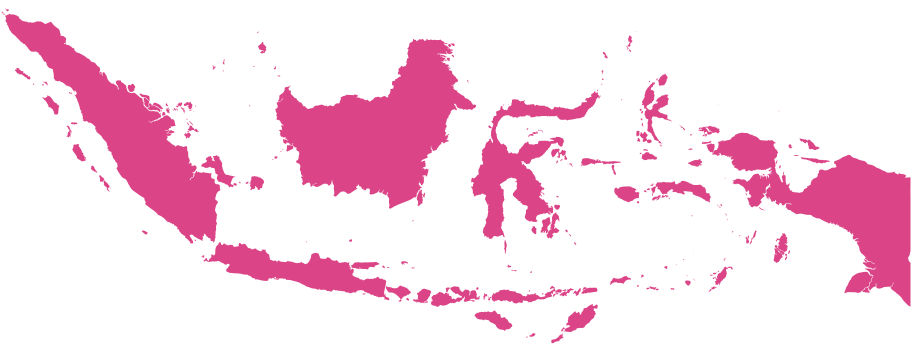
We have been working in Indonesia for more than a decade, where the death penalty remains in force and is applied particularly to drug-related offences. Our work has combined rigorous research, high-level engagement and a sustained effort to build the evidence base for abolition.
Indonesia retains the death penalty for what it defines as the ‘most serious crimes’, with drug crime accounting for the majority of those living under a sentence of death. Indonesia last carried out an execution in 2016, but maintains a death row population of more than 500 people.
We began working in Indonesia in 2015 at the invitation of local partners to initiate high-level meetings with governments entities and other policymaking stakeholders.
In the years that followed, we organised a series of workshops in partnership with the Swiss Embassy and the Indonesian government, bringing together international and national experts to examine international standards and practices around capital punishment.
We have provided legal representation to individuals facing the death penalty in Indonesia.
Central to our work has been the development of rigorous academic research. In partnership with LBH Masyarakat, the University of Indonesia, and the Death Penalty Research Unit (DPRU) at Oxford, we commissioned research into attitudes towards the death penalty in Indonesia. The findings were striking, with 67% of opinion formers in favour of abolition.
With Atma Jaya University and DPRU, we went on to co-direct a major three-year study mapping the political economy of drugs and the death penalty across Southeast Asia, with Indonesia as the central case study, exploring the social and economic motivations of those convicted of drug offences. In early 2026, we travelled to Indonesia to launch the findings, at an event attended by government ministers, academics and human rights organisations. These studies inform our engagement with legislators and policymakers in Indonesia and the wider region.
We continue to build on our research findings and deepen our engagement with government and civil society in Indonesia, pressing for reform based in evidence. Since Indonesia is due to become abolitionist de facto in 2026 due to it being ten years since its last execution, we will advocate for the state to commit to full de jure abolition of capital punishment, rather than becoming stuck in this in between status.